Research · Britain’s Dental Pain Index, 2026
Britain isn’t just struggling to see a dentist. It’s quietly Googling how to cope without one.
We looked at three months of the questions the UK brings to our own site: 5.9 million search impressions across our cost and pain guides. Four in five of them were about one of just two things. What dentistry costs, and what to do when you’re in pain and can’t get seen.
In brief · The findings, numbered
Seven things this data shows.
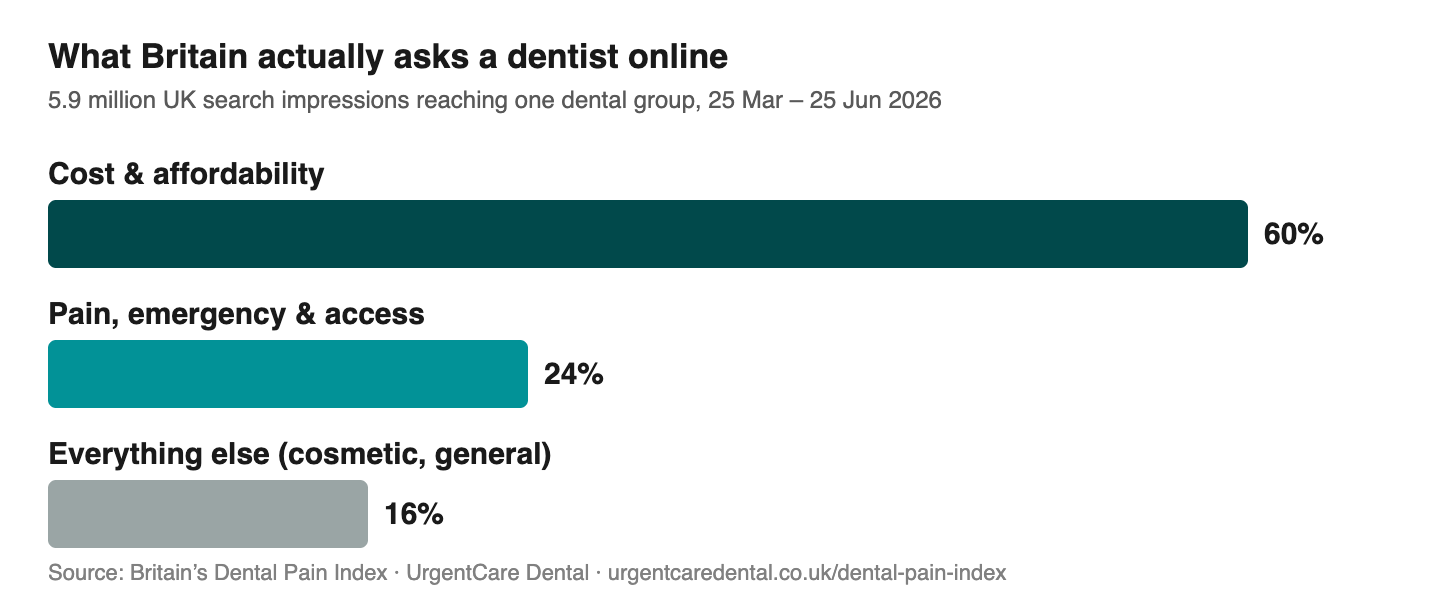
- 79% of dental search demand is cost or pain. Of 5.9 million UK impressions reaching our guides in three months, 60% asked what dentistry costs and 24% asked about pain, emergencies and access. Cosmetic and general questions, combined, were the remaining 16%.
- The single biggest question in British dentistry is "NHS or private, and what will each cost me." Our NHS-versus-private costs guide alone was shown 385,706 times in three months, more than any other page we run.
- Tooth replacement is priced like a major purchase. Implant, denture and crown cost guides drew 870,904 impressions between them: people comparison-shop teeth the way they comparison-shop cars, because for many households it is that scale of decision.
- Pain searches peak where access is thinnest. "Best thing for toothache" (284,774 impressions) and abscess guidance (222,822) are people managing symptoms themselves, in volumes that dwarf any cosmetic topic.
- A measurable slice of Britain is researching self-treatment. In three months, 5,437 searches for "ibuprofen for toothache", 1,498 for the easiest way to get antibiotics for a tooth infection, and 946 asking whether to pull out their own loose crown reached one dental group's site.
- The public record explains why. The BDA reports 13 million people in England unable to access NHS dentistry and up to 96% of NHS practices closed to new adult patients; YouGov found one in ten Britons has attempted DIY dentistry.
- The demand has postcodes. "Emergency dentist Leeds" alone reached us 4,866 times; our Leeds, Manchester and Bradford emergency pages drew over 46,000 impressions between them.
Finding one · Not whitening. Not smiles. Cost and pain.
Four in five questions are cost or pain.
Between 25 March and 25 June 2026, our guides appeared in UK Google results 5,903,520 times. When we sorted every one of those impressions by what the person was actually asking, the shape of it told the whole story: 60% were about cost and affordability ("how much is a dental implant", "NHS vs private prices", "cheapest dentures"), and another 24% were about pain, emergencies and access ("toothache at night", "dental abscess", "can't afford a dentist"). Everything else, all the cosmetic and general questions put together, made up the remaining 16%.
It's worth sitting with that for a second, because it cuts against the picture of private dentistry the industry likes to paint. The public conversation is veneers and whitening and straighter smiles. The private search bar says something else: the country's overwhelming dental preoccupation is whether it can afford to fix what hurts.
Finding two · The cost questions, up close
Britain prices its teeth like a major purchase.
The biggest single page in this dataset isn’t a treatment guide at all. It’s the comparison: NHS versus private dentist costs, shown 385,706 times in three months. That page answers the question a decade of dental-access decline has planted in millions of heads at once: if I can’t get an NHS appointment, what does the alternative actually cost, and can I carry it?
Behind it come the big restorations, in almost perfect order of price: single tooth implant cost at 364,759 impressions, dentures cost at 285,067, dental crown cost at 221,078. Those aren’t idle questions. Nobody researches denture prices for fun. Each of those impressions is somebody with a gap, a failing tooth, or a parent with one, doing the arithmetic before they dare book anything.
The query data underneath adds a telling detail: 18,728 searches for "nhs dentist prices" and another 14,866 for "nhs dental charges 2026" reached us in the same window. People aren’t just pricing private care; they’re trying to find out what the NHS itself would charge them, if only they could get in. When the public can’t easily discover the price of the public option, something in the information layer of the system has failed, and the search bar is where that failure shows up.
What the cost cluster tells us, plainly: price transparency isn’t a marketing nicety in dentistry. For three and a half million searches a quarter, it is the whole question.
Finding three · The pain questions, up close
A quarter of everything is someone hurting.
The pain cluster is smaller than the cost cluster and heavier to read. Its biggest page is "best thing for toothache": 284,774 impressions in three months from people whose search suggests they are not on their way to a dentist, they are managing a hurting tooth where they are. Close behind sits dental abscess and antibiotics at 222,822, then a swollen face from a toothache at 118,805, a crown that’s come loose at 111,281, and, saying the quiet part in eight words, "dental pain, can’t afford a dentist" at 55,844.
Read as a sequence, those five pages sketch the arc of an untreated dental problem: the ache, the infection, the swelling, the failing dental work, and finally the admission that cost is the thing standing between the person and the chair. Clinically, that arc has a shape too. A toothache seen early is often a filling. The same tooth after weeks of ibuprofen and salt water is a root canal or an extraction. The swelling stage can be genuinely dangerous. Every step along the search sequence is a step up in what the fix costs and what the person has been through, which is why the pain cluster and the cost cluster are really one story told twice.
Finding four · The searches nobody plans to make
What people search when they can’t get seen.
Some of the queries that reach us aren’t research. They’re what going without a dentist looks like, typed into a phone, usually late. These three deserve to be looked at one at a time, because each is a different kind of coping.
"Ibuprofen for toothache", 5,437 searches. The mildest of the three, and the most universal: pain relief while you wait. The honest clinical answer, which our guide gives, is that ibuprofen genuinely helps dental pain and buys time, and that’s all it does. The cause keeps progressing underneath the relief, which is precisely why "it settled down for a few weeks" is one of the most common sentences in our emergency clinics.
"Easiest way to get antibiotics for a tooth infection", 1,498 searches. This one carries more weight. It’s a person who has correctly diagnosed themselves with an infection and is trying to source the treatment without the dentist, because the dentist is the part they can’t get or can’t afford. The honest answer matters here: antibiotics can calm a dental infection, but they cannot cure one, because the source lives inside the tooth where antibiotics don’t reach. The infection comes back, often harder. That truth is on the page those searches land on, along with what actually fixes it.
"My crown is loose, should I pull it out?", 946 searches. The furthest point on the map: a person weighing up doing the extraction themselves. Our loose crown guide exists so that the answer they find is a calm no, an explanation of what a loose crown actually needs, and a same-day route to someone who can do it properly.
We’d rather those searches found honest help than silence. That’s the reason these guides exist, and it’s the reason this page does too: the responsible answer to a desperation search is a genuinely useful page with a fair price on the other end of it, not a lecture.
The context · The access gap, in named public figures
The country this data comes from.
Our search data shows the demand. The public record explains it, and it’s worth laying out properly, because the numbers are stark even before our data is set beside them.
The access gap. The British Dental Association reports that 13 million people in England are unable to access NHS dentistry, roughly one in four adults. A BDA investigation with the Mirror found up to 96% of NHS practices unable to take on new adult NHS patients, and one in ten English constituencies with no NHS dentist taking new adult patients at all. Whatever the national politics of that, the practical experience underneath it is simple: for a very large share of the country, "just see an NHS dentist" is not currently an instruction that can be followed.
What people do about it. This is where our data sits. Denied the front door, people go to the search bar: they price the private option (60% of everything we see), they manage the pain (24%), and a measurable few research treating themselves. The searching is the quiet middle of the story, the part that doesn’t show up in waiting-list statistics because the person never made it onto a list.
The endpoint. YouGov polling from March 2023 found that one in ten Britons has attempted DIY dentistry, and among those, 34% tried to pull out their own teeth. Three years on, a February 2026 Thinkmoney survey of 2,000 adults, reported by Dentistry.co.uk, found the pattern still running: of those who’d attempted DIY dentistry, 35% had pulled a tooth with pliers, a third said private care felt too costly, and three in ten couldn’t get an NHS appointment. The pliers are the end of the same arc that starts with "ibuprofen for toothache".
Put the three layers together and the story tells itself: the access gap, then the searching, then the pliers. Our dataset is the only current, granular window we know of on the middle layer, which is exactly why we’ve published it.
The regional cut · The same story, city by city
The demand has postcodes.
National numbers can feel abstract. These don’t, because we can see exactly where the emergency demand reaching us comes from, and it maps onto the three cities we serve.
Leeds. In the three-month window, "emergency dentist leeds" reached our pages 4,866 times, "urgent dental care leeds" 838 times, and, tellingly, "nhs emergency dentist leeds" 384 times, people looking for the NHS route and landing on a private page because that’s what answered. Our Leeds emergency pages drew more than 23,000 impressions between them. Leeds is where we built our flagship clinic, and this demand is why it runs around the clock.
Manchester. Our Manchester emergency and dentures pages drew over 18,000 impressions, and the searches skew late: the page that answers a 2am toothache in Manchester ranks precisely because that search exists at 2am, in volume. A city of Manchester’s size with its NHS access profile produces a steady overnight stream of people who need a dentist before morning and are told, everywhere else they look, to wait.
Bradford district. Our Bradford emergency page drew 5,426 impressions in the same window, in the district where our newest clinic opened on Bingley Main Street this July. We put a clinic there for the same reason this page exists: the demand was visible in the data long before there was a door for it.
Each city now has its own full cut of this index, mapped hour by hour through the night: Leeds, Manchester, and the Bradford district.
From the chair · What the searches look like in person
Where the searches end up.
Every pattern in this dataset walks into our clinics eventually, and usually later than it should. The person who searched "ibuprofen for toothache" in March arrives in May with an abscess. The person who researched sourcing their own antibiotics arrives after the second course has stopped working. The loose-crown searcher arrives with the crown in a tissue, and sometimes with damage a careful removal would have avoided.
The clinical cost of that delay is the part the search data can’t show. A cavity caught at the "best thing for toothache" stage is often a filling, from £20-assessment territory into low hundreds. The same tooth after months of coping is a root canal, a crown, or an extraction and a gap that then poses its own set of questions, the implant-and-denture questions that dominate the cost cluster. The two biggest halves of this dataset, the pricing of major restorations and the managing of untreated pain, are cause and effect wearing different clothes.
That’s the practice’s honest reading of its own data, and it’s why our model is built the way it is: a £20 assessment with X-rays included so that finding out what’s wrong is never the barrier, written quotes before treatment so the cost question is answered before the chair, and finance so a necessary fix doesn’t have to wait for payday. None of that fixes national access. It fixes the piece in front of us.
If this page found you in pain · The useful part
What actually helps, tonight.
If you arrived here from one of the searches above, the honest guidance is short. Ibuprofen and paracetamol, taken as their packets direct, genuinely help dental pain while you arrange care; a cold compress helps swelling; salt-water rinses help an irritated gum. What none of them do is fix the cause, so treat them as the bridge, not the destination. Our guides go deeper on easing toothache safely, getting through a night with a toothache, and what antibiotics can and can’t do.
And the NHS’s own red lines are worth knowing: swelling that affects your breathing or swallowing, bleeding that won’t stop, or a serious facial injury belong at A&E or 999, tonight, no question. For everything tooth-shaped short of that, NHS 111 can point you at urgent NHS options, and if those come up empty or too slow, here’s the honest picture of who can do what, and we’re open around the clock in Leeds, Manchester and Bradford.
Questions about this study
Asked and answered.
Is this data national?
No, and we say so plainly. Every original figure here is search demand reaching one UK dental group's website: a large, consistent window into what Britain asks, but a window, not a census. Where a national figure appears on this page (NHS access, DIY dentistry), it comes from a named public source: the British Dental Association, YouGov, or the Thinkmoney survey reported by Dentistry.co.uk.
Can I republish the charts?
Yes, freely, with a credit link to this page. The embed code at the bottom of the page has the image and the credit ready to paste. Journalists who want the full breakdown, the regional cut for their city, or a clinician's comment can contact the practice and ask for the Dental Pain Index dataset.
How were the searches classified?
We took our 100 most-shown pages over the three-month window and sorted each page and its queries into one of three intent clusters by what the searcher was asking: cost and affordability, pain, emergency and access, or everything else. The sums are computed by a script, not estimated, and the workings are re-runnable against the same Search Console data at any time.
Why is a private dentist publishing this?
Because we sit at the exact point where these searches land. People reach our guides at the moment they're weighing up a cost or coping with a tooth at 2am, so our search data captures something the national statistics can't: the questions themselves, in people's own words. We publish it because the pattern deserves to be seen, and because the honest answer to most of those questions is that early, transparent, affordable care exists.
What should I do if I'm in pain and worried about cost?
Get the tooth looked at before it grows. Our emergency assessment is £20 with X-rays included, the exact price of any treatment is agreed in writing before it starts, and 0% finance is available on larger work. A problem seen this week is almost always smaller and cheaper than the same problem seen next month, which is the one piece of advice this whole dataset shouts.
Methodology · The workings, openly
How the numbers were made.
Source and window. Every original figure on this page comes from Google Search Console data for urgentcaredental.co.uk, 25 March to 25 June 2026, a clean three-month window across our 100 most-shown pages. Search Console records an impression each time one of our pages appears in a UK Google result, and a click each time somebody chooses it; the window contained 5,903,520 impressions and 39,954 clicks.
Classification. Each page, with its queries, was classified into one of three intent clusters by what the searcher was asking: cost and affordability (price guides, NHS-versus-private comparisons, finance questions), pain, emergency and access (symptom guides, emergency questions, "can’t get seen" and "can’t afford" queries), or everything else (cosmetic and general dentistry). The sums are computed by a script rather than estimated, and the workings can be re-run against the same data at any time.
What this is and isn’t. These are search impressions reaching one UK dental group: a large, consistent window into national demand, not a national total, and nothing here claims otherwise. Our pages rank well on exactly these topics, which is why the window is wide; it also means cosmetic demand may be under-represented relative to sites that specialise in it, a bias we note rather than hide. The external figures, NHS access and DIY dentistry, belong to their named sources: the British Dental Association, YouGov, and Thinkmoney via Dentistry.co.uk, each linked where cited.
For journalists. The full breakdown, the regional cut for your city, and a clinician’s comment are all available: contact us via the practice and ask for the Dental Pain Index dataset. We’ll show the workings.
And if you’re reading this because your tooth hurts…
You don’t have to cope alone, and you don’t have to guess what it costs. A £20 emergency assessment, X-rays included, gets you seen today at our clinics in Leeds, Manchester and Bradford, and the exact price of any treatment is agreed in writing before anything starts.