Dental Implants
All-on-6 vs All-on-4 Dental Implants: Which One and What's the Difference?


Four implants to hold a full jaw of teeth: all of your new teeth connect together as one bridge, and that bridge sits on just four implants. That's All-on-4, and it's one of the most elegant solutions in modern dentistry. But then someone mentions All-on-6, and a question appears that wasn't there before: if four implants work, why would anyone want six? And if six is better, why doesn't everyone get six?
The answer is satisfyingly specific. The lower jaw is dense and strong, so four implants do the job beautifully. The upper jaw is softer, which is why six implants there give better long-term stability. Most people end up with four on the bottom and six on the top, though the exact recommendation depends on the bone. And the price difference between them, which is £3,000-£6,000 per jaw, is worth understanding.
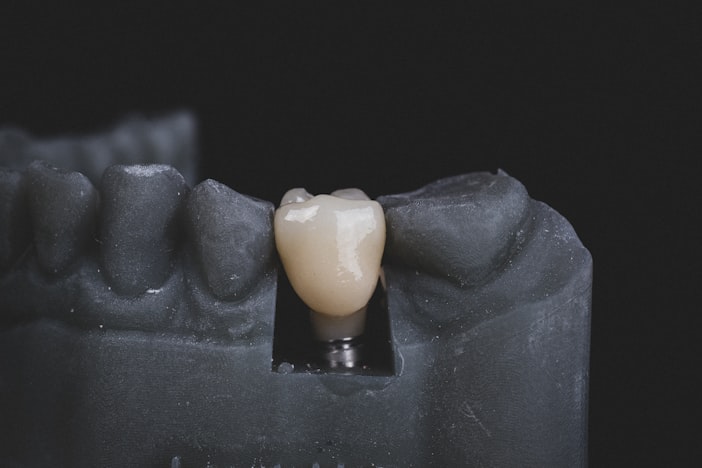
And just so you don't get the image in your mind of having only four teeth on the bottom and six on the top: These are the implants we're talking about here. The contact points that your new teeth go all on. Now you know why they're called all-on-4 and all-on-6.
The short version: four implants go where the bone is dense, which is usually the lower jaw, and six go where it's softer, which is usually the upper, so most people end up with four on the bottom and six on the top. The price gap works out at roughly £3,000-£6,000 per jaw, and the rest of this page walks through exactly where that extra money goes and when those two additional implants earn their keep.
Here's the head-to-head at a glance, so you can take in the whole comparison in a couple of seconds:
| Feature | All-on-4 | All-on-6 |
|---|---|---|
| Implants per jaw | 4 (two straight at the front, two angled at the back) | 6 (spread evenly across the arch) |
| Cost per jaw | £8,000-£16,000 | £11,000-£22,000 |
| Best suited to | Dense lower jaw, moderate bone loss | Softer upper jaw, grinders, a heavier bite |
| How the force is spread | Great, with a slight cantilever at the very back | Across six points, so there's more margin |
| Bone needed | Often avoids grafting thanks to the angled implants | More bone volume across a wider area |
| Time in the chair | 2-3 hours per jaw | 2.5-4 hours per jaw |
| 10-year survival | 94-98% | 94-98% |
The Cost Difference Between Them
All-on-4 runs £8,000-£16,000 per jaw, which comes to roughly £20,000-£30,000 for both upper and lower. All-on-6 runs £11,000-£22,000 per jaw, so £25,000-£40,000 for both. The extra cost comes from two additional implant fixtures, slightly longer surgery, and a bridge design that distributes force across six points instead of four.
How All-on-4 Dental Implants Work
The concept has been around for over two decades, and the clever bit is how the implants are positioned. The two at the front go in straight. The two at the back go in at an angle, which lets them grip into stronger bone while avoiding the areas that would cause problems. A full arch bridge clips across all four, holding 10-14 teeth per jaw, and the ten-year survival rates sit at 94-98%, which is excellent by any measure.
The lower jaw suits four implants particularly well because the bone there is naturally dense and strong. Four well-placed implants provide more than enough support.
So Why Would Anyone Want Six?
The upper jaw. That's really where the conversation starts, because the upper and lower jaws are, structurally speaking, completely different beasts.
The lower jaw is dense, compact, strong. Four implants in the mandible have more than enough bone to grip onto, which is why All-on-4 works so brilliantly there. The upper jaw though is softer, more porous, and has the maxillary sinuses taking up space where bone could be. Each implant simply has less to hold onto. Two extra implants spread the chewing force across a wider area, so each one carries less load. And if one of them doesn't integrate perfectly, the other five keep the bridge rock solid. With four in soft bone, there's less margin for that kind of thing.
The ten-year survival rates are actually very similar for both approaches (94-98% for each), which surprises people. The difference isn't about whether the treatment works; it's about how much safety margin is built into the system. In dense lower jaw bone, four implants have plenty. In softer upper jaw bone, six buy breathing room.
Most implant specialists recommend four for the lower and consider six for the upper, especially for patients with softer bone or a history of bone loss from gum disease.
The Hybrid: Four Below, Six Above
Something that's becoming increasingly common, and for good reason: All-on-4 in the lower jaw, All-on-6 in the upper. Ten implants total instead of eight or twelve, which recognises that the two jaws are fundamentally different structures and treats them accordingly.
The cost for this hybrid sits around £22,000-£35,000 for both jaws, depending on the bridge material and the region. Many experienced implant surgeons consider this the optimal balance of cost, engineering, and clinical outcomes for full mouth restoration. There's also a variation worth knowing about called 3-on-6, which still uses six implants but splits the new teeth into three separate bridges rather than one continuous piece, so a single section can be worked on later without disturbing the rest.
What Determines the Choice
The decision isn't one you need to make before walking into a consultation. It emerges from what the CT scan shows about your bone.
If the scan reveals good, dense bone in both jaws, All-on-4 provides excellent results at a lower cost. If the upper jaw is softer or has experienced significant resorption, six implants there offer meaningful extra security. Teeth grinding is a consideration too, since grinders exert two to three times normal biting force over decades, and extra implants provide additional resilience against that. Even the bridge material plays a role: a heavier zirconia bridge transmits forces differently from a lighter acrylic one, and some clinicians prefer six implants when placing zirconia in the upper jaw.
The clinician who's looking at your three-dimensional bone scan has information you don't. If they recommend six, it's because your bone tells a story that benefits from the extra support. If they recommend four, the bone is strong enough that additional implants would add cost without adding meaningful benefit.
Surgery and Recovery
The surgical experience is similar for both. All-on-4 takes 2-3 hours per jaw. All-on-6 takes 2.5-4 hours, the extra 30-60 minutes for two more implant sites. Both approaches provide same-day teeth: the temporary bridge is fitted immediately, and you walk out with a full set of functioning teeth that day.
IV sedation is available for anyone who'd rather the procedure pass without awareness. Recovery is the same for both: swelling peaking at 48-72 hours, soft foods for the first few weeks, most people back to normal activities within a week. The two extra implant sites don't change the recovery experience because the surgical area is the same: the jawbone under the gum.
What About Years Down the Line?
One thing that's nice about this decision: whichever you go with, the ongoing maintenance is identical. Professional cleaning twice a year (the hygienist uses specialised instruments to get under the bridge where a toothbrush can't reach), a water flosser or interdental brushes at home, and that's really it. The implants themselves are titanium, so they can't decay, though the gum tissue around them still needs looking after the same way natural gums do.
The bridge on top is where the long-term maths gets interesting. An acrylic bridge lasts about 10-15 years before it needs replacing (£1,500-£3,000 for the lab work, and the implants underneath stay exactly where they are). A zirconia bridge lasts 20-25 years or potentially longer, which is part of why some people choose the higher upfront cost. Either way, the four-vs-six decision makes no difference to any of this. Once the bridge is in place, the foundation underneath is invisible.
Common Questions About All-on-4 and All-on-6
Is all-on-6 better than all-on-4?
Neither one is simply "better," and that's genuinely good news, because it means the choice gets to be about you rather than about a ranking. All-on-6 gives you extra security in softer bone, which is why it's so often the pick for the upper jaw, while all-on-4 does a beautiful job in the dense bone of the lower jaw for less money. The better option is whichever one matches what your CT scan shows about your bone.
What is the downside of all-on-4 dental implants?
The honest one is margin. With four implants, if a single one is slow to integrate there's less backup than with six, and there's a slight cantilever effect at the very back of the bridge where it reaches past the last implant. In dense lower-jaw bone that margin is plenty, which is exactly why all-on-4 is so trusted there. It's when the bone is softer that a lot of clinicians reach for six instead, purely to build in more breathing room.
Is all-on-4 better than individual implants?
For a full arch of missing teeth, it usually is, and the reason is a lovely one: four well-placed implants can hold ten to fourteen teeth as one solid bridge, whereas replacing every tooth on its own could mean eight or more separate implants, far more surgery, and a far bigger bill. Individual implants shine when you're replacing one or two teeth in a mouth that's otherwise healthy. Once a whole arch is gone, all-on-4 gives you a fixed, full set of teeth with much less hardware in the bone.
How much more does all-on-6 cost than all-on-4?
All-on-4 runs £8,000-£16,000 per jaw and all-on-6 runs £11,000-£22,000, so the extra two implants add somewhere around £3,000-£6,000 per jaw. That difference pays for two more implant fixtures, a slightly longer surgery, and a bridge designed to spread your bite across six points instead of four. Whether it's worth it comes down to your bone, which is a consultation conversation rather than a fixed rule.
Which is better for the upper jaw?
This is the one place the answer leans firmly one way. The upper jaw is softer and more porous than the lower, and the maxillary sinuses take up room where bone could be, so each implant there has less to grip onto. Six implants spread the load across a wider area and leave more margin if one is slow to settle in. That's why, when people end up with a mix, it's almost always six on the top and four on the bottom.
What is the newest type of dentures?
The modern move is away from removable dentures altogether and toward fixed, implant-held teeth like all-on-4 and all-on-6. Instead of a plate that comes out at night and can rock while you eat, your new teeth clip permanently onto implants set into the jaw, so they stay put, feel like your own, and let you bite into things a traditional denture never really could. It's the same idea as a denture, a full set of teeth, done in a way that stays with you day and night.
The Consultation
At UrgentCare Dental, the implant consultation includes CT imaging and a thorough assessment of bone volume and density. The recommendation comes from the clinical picture rather than a one-size-fits-all philosophy. Payment plans can spread the cost across manageable monthly instalments, and knowing the exact figure before committing means the financial decision is as informed as the clinical one.
Four implants hold a full jaw of teeth. Six hold a full jaw with extra security. Both have decades of clinical evidence, excellent success rates, and outcomes that genuinely transform lives. The right answer is the one that matches your anatomy, and the consultation is where that answer becomes clear.
Want the real number for your case?
An article can only give you a range. The £20 appointment gets you a fixed quote from a dentist who has actually looked. Extractions from £199, implants £1,999, and 0% finance on treatments over £500.
Or see every price on one page →